
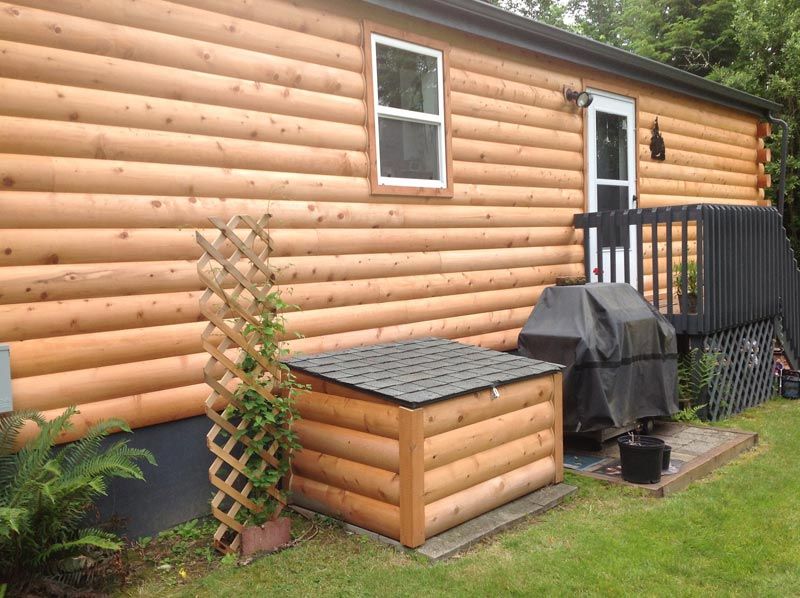
Log siding is one of the most common ways people get the look of a log cabin without building with full logs, and it is a product we cut every week at our mill in Boone, North Carolina. Maybe you are wrapping a new framed home in the mountains, freshening up an older cabin, or pricing out a lake house where the budget has to stretch a little further. Whatever brought you here, the choices come down to the same three things. You pick a profile, you pick a species, and you plan how it goes on the wall.
This guide walks through all three the way we would explain them if you stopped by the shop. We will cover the log cabin siding profiles we mill, how each wood species behaves on an exterior wall, the sizes and textures available, and what your builder needs to know before the first course goes up. We are powered by Reliance Timber, so the advice comes from the people running the saws, with no middleman in between.
What Is Log Siding?
Log siding is exterior wall cladding milled to look like stacked logs. One face is shaped to show a log profile, usually rounded, and the back is cut flat so it fastens tightly to a conventionally framed and sheathed wall. From the street, a home clad in log siding reads as a log home. Behind the siding, the wall is a standard stud wall with insulation, wiring, and plumbing run the way any builder in your area already knows.
That is the main reason people choose it. You get the warmth and character of wood on the outside while keeping the framing method, insulation approach, and construction schedule your builder is used to.
Log Siding vs Full Log Walls
A full log wall is the structure. The logs carry the load of the roof and form the wall itself, inside and out. Log siding is a finish layer over a framed wall, which changes how the house is built, how it settles, and what the inside looks like.
Here is how the two compare at a glance.
| Log siding | Full log walls | |
| What it is | Exterior cladding over a framed wall | The structural wall system itself |
| Interior look | Your choice of drywall, paneling, or wood | Logs show inside unless covered |
| Construction | Standard framing that most builders know | Log stacking, often with a log home crew |
| Settling | Framed walls follow conventional framing behavior | Log walls settle over time and need planning for it |
| Corners | False corners can give it a full log look | Notched or post corners cut from the logs |
Neither one is the better choice for every build. Full logs give you that solid wood feel from both sides of the wall, and log siding gives you more flexibility inside and a build process closer to a conventional home.
The Log Siding Profiles We Mill
The profile is the shape you see on the wall, and it sets the whole personality of the house. True log siding comes in three profiles, D log, German chink and square chink, and each one gives a framed wall the look of stacked logs. You can see these profiles next to our corner styles on our logs and corners page.
D Log Siding
D log siding is rounded on the face and flat on the back, so the end of each board looks a bit like the letter D. Once it is on the wall, it gives you the classic stacked log look most people picture when they think of a cabin in the Smokies or the Blue Ridge. It is the profile we get asked about most, and it pairs well with false corners for a home that looks like it was built from full logs.
German Chink Log Siding
German chink log siding has a flat face with a curved cove cut along its edges, so a clean chink line runs between each course. It gives you the look of a hand-built log home with traditional chinking between the logs, while the wall behind it is framed the way any builder knows.
Square Chink Log Siding
Square chink log siding also has a flat face, but its edges are cut square, which leaves a wider, squared chink line between courses. The result is a bold, blocky look that reads like hewn timber walls with chinking in between, and it suits American traditional and heritage style homes.
Wood Sidings for Gable Ends and Dormers
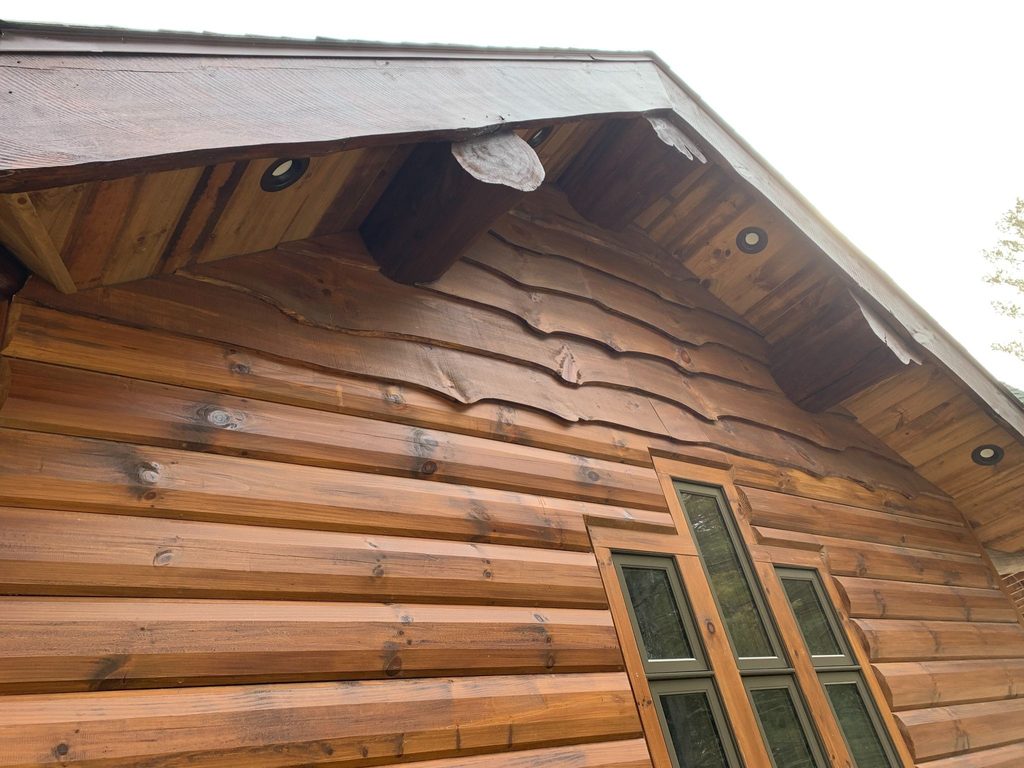
Log siding usually covers the main walls, and many log homes switch to a different wood siding up in the gable ends and dormers. It breaks up the look, adds texture where the roofline meets the walls, and lets you bring in a second style without taking away from the logs. You can choose any of the wood sidings below for those spots, and most of them are on our siding and exterior cladding page.
Channel Rustic
Channel rustic siding is a flat board milled so each course overlaps the next and leaves a clean shadow line, or channel, between boards. In a gable end, it gives a log home some contrast with cleaner lines, which works especially well on modern mountain designs.
Wavy Edge
Wavy edge siding keeps the natural edge of the tree along one side of each board, so every course has its own irregular, organic line. It has a rustic, handmade feel, and because no two boards are alike, it brings plenty of movement and texture to a gable or dormer.
Plain Bevel
Plain bevel siding is a lap siding board that is thicker along one edge and tapers toward the other, so each course laps over the one below. It sheds water well and gives a simple, traditional look that suits farmhouse and American traditional styles.
Poplar Bark
Poplar bark siding is made from the bark of poplar trees and has a deep natural texture you cannot get from milled boards. It has a long history in Appalachian building, and it makes a striking accent in a gable end or dormer when you want something rooted in the region. Reliance Timber has a full guide to poplar bark siding for log homes if you want to see more of it.
Cedar Shakes
Cedar shakes are thick, split cedar shingles with a rough, textured face. Up in a gable end or dormer, they add a layered look that contrasts nicely with the long horizontal lines of the log siding below.
If you are mixing log siding with wood sidings, which is common, choose them alongside your floor plan and elevations so the main walls, gable ends and dormers work together. Our post on modern mountain log home materials shows how combining different cladding changes the look of a home.
Choosing Wood Species for Log Cabin Siding
Species matter on an exterior wall because siding takes the sun, rain and humidity head on. We offer log siding in five species. We keep Eastern White Pine, Douglas Fir and Western Red Cedar in stock, and we special order Southern Yellow Pine and Cypress.
Eastern White Pine is the species we cut most. It grows in the mountains and foothills of western North Carolina, it is relatively stable with low shrinkage, and it takes stain well. Reliance Timber notes that White Pine is the best bet when you want a particular stain color. It is also the most budget-friendly species we sell. It needs a good stain and routine care outside because it does not have the natural decay resistance of cedar or cypress.
Western Red Cedar is the species people picture for a cabin that holds up to weather. It is naturally decay resistant, lightweight, and has a rich reddish-brown color. Reliance Timber lists siding among the uses it is best suited for. It costs more than pine, so many people use cedar where the weather hits hardest and pine elsewhere.
Douglas Fir brings strength and a warm, light brown color with hints of red and yellow. It is harder than white pine, which helps on walls that see more bumps and wear, like a porch or a busy entry.
Southern Yellow Pine is denser and stronger than Eastern White Pine and grows across the Southeast, so it is a familiar species for builders in our region. It is heavier, and it needs to be dried and installed well to keep movement in check.
Cypress pairs natural decay resistance with strength. Its grain looks a lot like cedar while its color sits closer to pine, and it machines cleanly. It is heavier than pine or cedar, and supply is usually limited, which is why it is a special order species for us.
The right species for your walls depends on your climate, the look you want, and your budget, and we are always glad to talk it through.
Log Siding Sizes, Textures, and Corners
Once you have a profile and a species, the next decisions are size, texture, and how the corners will look. These details are what make a framed home look like a log home up close.
Sizes
Thickness and width change the look of each course on the wall. Wider, thicker boards look more like full logs, and smaller sizes give a finer, tighter pattern. These are the nominal siding sizes on our wood sizes available sheet.
| Thickness | Widths available |
| 1 inch | 6, 8, 10 and 12 |
| 5/4 | 6, 8, 10 and 12 |
| 2 inch | 6, 8, 10, 12, 14 and 16 |
| 3 inch | 6, 8, 10, 12, 14 and 16 |
| 4 inch | 6, 8, 10, 12, 14 and 16 |
Your plans and the profile you pick will narrow these down, and we can help you match the size to the scale of the house.
Textures
We offer four textures for everything we make, including logs, posts and beams, siding and trim. You can choose smooth, rough-sawn, hand-hewn, or draw-knifed. A smooth face gives a cleaner look and takes stain evenly. Rough sawn adds a rustic feel. Hand-hewn and draw-knifed textures show the marks of the tools that shaped them, which is where log siding starts to look handcrafted.
False corners
Corners are where log siding can give itself away, and they are also where it can look most convincing. We make false corners that look like the ends of full logs, in false dovetail, saddle notch and butt and pass styles. Paired with D log siding, false corners give you a home most people will assume was built with full logs.
How Log Siding Is Installed
Log siding installation is work for your builder or siding contractor, and the exact details will follow your plans, your local building code, and the conditions on your site. We do not provide engineering or installation services. What we can do is explain the steps so you know what to expect and what to ask about.
Before the siding arrives
Every siding board we ship is kiln-dried, end-matched, and bundled for efficient installation and shipping. Kiln drying brings the moisture content down before the wood leaves the mill, which helps the boards stay put once they are on the wall.
On site, the bundles should be stored off the ground, covered and with some airflow, so the wood does not pick up moisture before it goes up.
Preparing the wall
Log siding goes over a framed, sheathed wall that has a weather-resistant barrier, the house wrap or building paper that keeps water off the sheathing. Many builders also leave a small air gap behind the siding, called a rain screen, so any water that gets behind the boards can drain and dry. Window and door openings get flashed before the siding goes on so water is directed out and away from the wall.
Sealing and finishing the boards
Wood takes on and releases moisture through every surface, and the cut ends soak it up fastest. Research from the USDA Forest Products Laboratory, in Improving the Performance of Painted Wood Siding, found that rain screens, sealing end grain, and back priming all help exterior wood siding perform better. In practice, that means your crew finishes the back and edges of each board and seals any end they cut on site before it goes up.
Running the courses
Installation usually starts with a level starter course at the bottom of the wall, and each course after that is checked for level as the wall goes up. With D log siding and other profiles that interlock, each board seats into the one below so the courses shed water down and away. End matched boards help the joints line up cleanly. Your builder will use corrosion-resistant fasteners so the wood does not stain around the nail heads and will follow the nailing pattern your plans and local code call for.
Corners, trim, and the final finish
False corners and trim go on as the walls come together, and then the whole exterior gets its first coat of stain. A good stain applied early protects the wood from sun and moisture right from the start.
Caring for Log Cabin Siding
Log cabin siding keeps its natural beauty for years with routine care. Plan to re-stain every 3 to 7 years, depending on how much sun your home gets and the color of your stain. Darker stains tend to last longer between maintenance coats.
For insect protection, we recommend mixing an insect repellent additive such as NBS-30 into your stain as part of your regular routine. Check that your stain manufacturer approves the additive, and always follow the label directions. Good roof overhangs and gutters, along with keeping plants and soil a little away from the bottom of the walls, go a long way toward keeping your siding dry and looking good.
What Affects the Cost of Log Siding
Every order is priced to your plans, so the cost of log siding comes down to a few main factors.
- Wall area. The size of your home and the square footage of the exterior walls to cover set the quantity.
- Species and size. Cedar and cypress cost more than pine, and thicker, wider boards use more wood than smaller ones.
- Profile, texture, and corners. Hand-hewn or draw-knifed textures and false corners add character and add to the material list.
Choosing pine for most of the walls and saving cedar or poplar bark for an accent is one easy way to stretch a budget without losing the look. The most accurate number always comes from a quote built from your plans.
Ordering Log Siding Mill-Direct
You can order log siding on its own or as part of a full custom material package cut to your plans. Many of our customers order individual products like siding, posts and beams, paneling and trim, while others want everything for the house coming from one mill.
Ordering works best when we can see your plans. Send us your drawings or your builder's materials list, along with the profile, species, and texture you have in mind and where you are building. Once your order is confirmed and placed, we can typically deliver within about four weeks, and we ship to job sites across the country.
Frequently Asked Questions About Log Siding
What is log siding?
Log siding is exterior cladding milled to look like stacked logs. It has a shaped face, usually rounded, and a flat back that fastens to a conventionally framed and sheathed wall. It gives a framed home the look of a log home on the outside.
Is log siding the same as a log home?
No. In a log home, full logs form the structural wall. With log siding, the structure is a standard framed wall, and the siding is the exterior finish. Paired with false corners, log siding can look very close to a full log home from the outside.
What is the best wood for log cabin siding?
It depends on your climate, look, and budget. Eastern White Pine is stable, takes stain well, and offers the best value. Western Red Cedar and Cypress bring natural decay resistance at a higher cost. Douglas Fir and Southern Yellow Pine add hardness and strength.
What log siding profiles does Log Cabin Supply offer?
We mill three log siding profiles, D log, German chink and square chink. For gable ends and dormers, we also mill wood sidings including channel rustic, wavy edge, plain bevel, poplar bark and cedar shakes. Our siding comes in a range of sizes and in smooth, rough sawn, hand hewn or draw knifed textures. Each one is cut to match the profile and species of your log siding.
Can I use log siding and still have log corners?
Yes. We make false corners that look like full log ends, in false dovetail, saddle notch, and butt and pass styles, so your siding can carry the look of a full log home around every corner.
Is your log siding kiln dried?
Yes. Each board is kiln-dried, end-matched, and bundled for efficient installation and shipping.
How long does log siding last?
With routine care, log siding keeps its beauty for many years. Plan to re-stain every 3 to 7 years depending on sun exposure and stain color, and mix an insect repellent additive such as NBS-30 into your stain to help keep carpenter bees and other insects away. Check that your stain manufacturer approves the additive first.
Can I order log siding without a full material package?
Yes. You can order it on its own or with other individual products like posts and beams, paneling, and trim. We can ship directly to your job site.
Ready to Start on Your Log Siding?
Whether you are planning a new log home, wrapping a framed house in the mountains or adding some cabin character to a place you already love, the right log siding starts with your plans. Tell us about the profile, species, and texture you are drawn to, and we will build your order around your design and ship it from our mill to your site. If you would like to see the wood in person first, we welcome visitors to the mill Monday through Friday (an appointment is always a good idea so we can give you proper time).
Send us your plans or talk with our team about your log siding. Your design, our logs. Let's build it together.